Sacramento, California

Commercial Concrete Contractor in Sacramento, CA

Commercial work is judged on two things: does the slab perform under load, and did the work happen without shutting the tenant down. Both are planning problems more than pouring problems.

We sequence commercial projects around access, deliveries and business hours, and we hold flatwork to the flatness and jointing requirements in the specification rather than to residential habits.

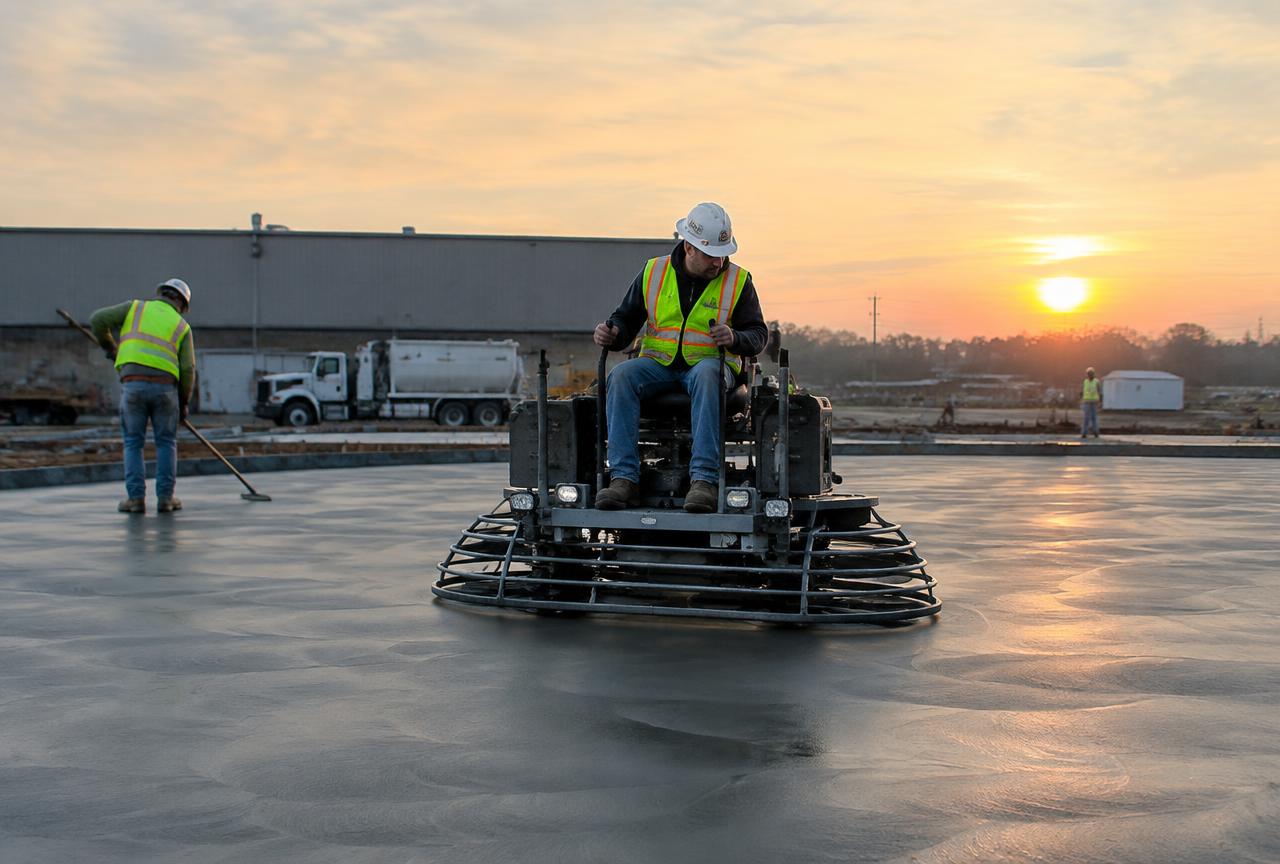
Crew power-troweling a large commercial concrete slab at sunrise
Scope
Warehouse and industrial slabs, parking, dock aprons, pads, TI flatwork
Tolerances
Placed and finished to project FF/FL requirements where specified
Jointing
Engineered joint layout with dowel baskets or plate dowels at construction joints
Scheduling
Night, weekend and phased pours to keep operations running

Slabs designed for the actual load

A slab under forklift traffic and rack posts is a different animal from a warehouse floor that stores pallets on the ground. We build to the design loads in the drawings - thickness, reinforcement, joint spacing and dowel detailing all follow from them.

  • Thickness and steel per the structural design, not a default
  • Dowel baskets or plate dowels for load transfer at construction joints
  • Thickened sections at rack lines, dock edges and equipment pads

Parking lots, ADA and site flatwork

Site concrete is where jurisdictions look hardest. Accessible stalls, path-of-travel slopes, curb ramps, detectable warning surfaces and cross-slopes all have numeric limits, and an inch of error becomes a correction notice.

  • Accessible stalls and access aisles built within slope tolerance
  • Curb ramps with compliant detectable warning surfaces
  • Valley gutters and drainage graded to the civil plan

Working around an operating business

We phase pours so entrances, docks and drive lanes stay usable. That means smaller pours, more joints planned in advance, temporary ramping and clear signage rather than one large closure that costs the tenant a week.

  • Phased layouts that keep at least one access route open
  • Night and weekend placement where daytime work is not workable
  • Temporary plating and ramping over open trenches and fresh work

Repair, replacement and joint rehabilitation

Not every failing commercial slab needs replacing. Spalled joints, faulted panels and localized damage can often be repaired in place for a fraction of the disruption, which keeps capital available for the areas that genuinely need reconstruction.

  • Full-depth panel replacement where deterioration is structural
  • Joint arris repair and semi-rigid joint filling in traffic aisles
  • Grinding and diamond-polishing of existing floors as an alternative to overlay

In depth

Commercial Concrete in Sacramento, explained properly

Phasing work around an operating business

A commercial slab replacement rarely comes with a closed site. Tenants need deliveries, customers need a path, and the fire lane has to stay usable. We phase pours so a portion of the lot or dock stays in service, set construction joints at phase lines so the joint is a designed element rather than a cold seam, schedule noisy demolition outside trading hours where the jurisdiction allows it, and maintain barricades and signage to keep foot traffic away from green concrete. The concrete is the straightforward part; the logistics are what make or break the schedule.

Load paths, dock aprons and heavy wheel traffic

Passenger vehicle parking, truck drive aisles and a dock apron are three different structures even when they look like one paved surface. Wheel loads at a dock concentrate at the bumper line and at the approach transition, so thickness, reinforcement and jointing change there. We build the drive aisle and apron heavier than the stalls, dowel across construction joints where load transfer matters, and detail the transition to asphalt or existing concrete so the edge is supported rather than cantilevered over a soft shoulder.

Accessibility and code compliance on the finished surface

On commercial sites the finished slope tolerances are enforceable, not advisory. Accessible stalls and access aisles have slope limits in every direction, path of travel has running and cross slope limits, and curb ramps have flare and landing requirements. We shoot grades before pouring, verify with a level after screeding while there is still time to correct, and document the result. Fixing a noncompliant accessible stall after cure means removing and repouring it, so the check happens while concrete is still workable.

What we build to

Standards and specifications on every commercial concrete project

  • Load transfer dowels at construction joints in traffic areas
  • Thickened sections at dock aprons and drive aisle turning points
  • Accessible stall and path of travel slopes verified before final finish
  • Phased pours with designed construction joints at phase lines

What goes wrong elsewhere

The failures we are called in to replace

  • Treating the entire lot as one uniform slab section
  • Sawing joints late on a large placement, where restraint is highest
  • Unsupported edges at the transition to existing asphalt
  • Accessible slopes checked only after the concrete has cured
  • No traffic plan, so the public walks across a curing surface

Local conditions

How Sacramento ground changes this work

Industrial corridors in West Sacramento, Rancho Cordova and north Sacramento carry heavy distribution traffic on subgrades that vary within a single parcel. We proof roll the whole footprint rather than assuming the far corner behaves like the area near the building.

Before you call, it helps to have

  • Define hours of operation and which areas must stay open
  • Identify the heaviest wheel loads the surface will carry
  • Confirm accessible route requirements affected by the work
  • Agree the phase map before mobilization
877-889-1187

Questions

Commercial Concrete - frequently asked

Still unsure? Call 877-889-1187 and describe the site. We would rather talk you out of unnecessary work than sell it to you.

Yes. Night and weekend placement is standard for occupied retail, industrial and medical sites where daytime closures are not acceptable. It is a scheduling and lighting question, not a technical obstacle.

Talk to a concrete contractor who works in Sacramento every day

Describe the slab, the site and what is going wrong. You will get a straight answer about what the work involves - including when we think you do not need us.

Mon-Sat 7:00 AM - 6:00 PM · Sacramento, Elk Grove, Roseville, Folsom & surrounding valley

Call 877-889-1187