Sacramento, California

Concrete Driveway Installation in Sacramento, CA

A driveway is the largest single slab most Sacramento homeowners will ever own, and it fails for predictable reasons: soft subgrade, missing reinforcement, joints cut too late, and water that never had anywhere to go. We build driveways backward from those failure modes.

Sacramento sits on a mix of alluvial silts near the rivers and expansive clays out toward Elk Grove, Antelope and Rancho Cordova. Those soils swell in the wet season and shrink hard through the delta-breeze summer. A driveway that ignores that movement telegraphs it within two seasons.

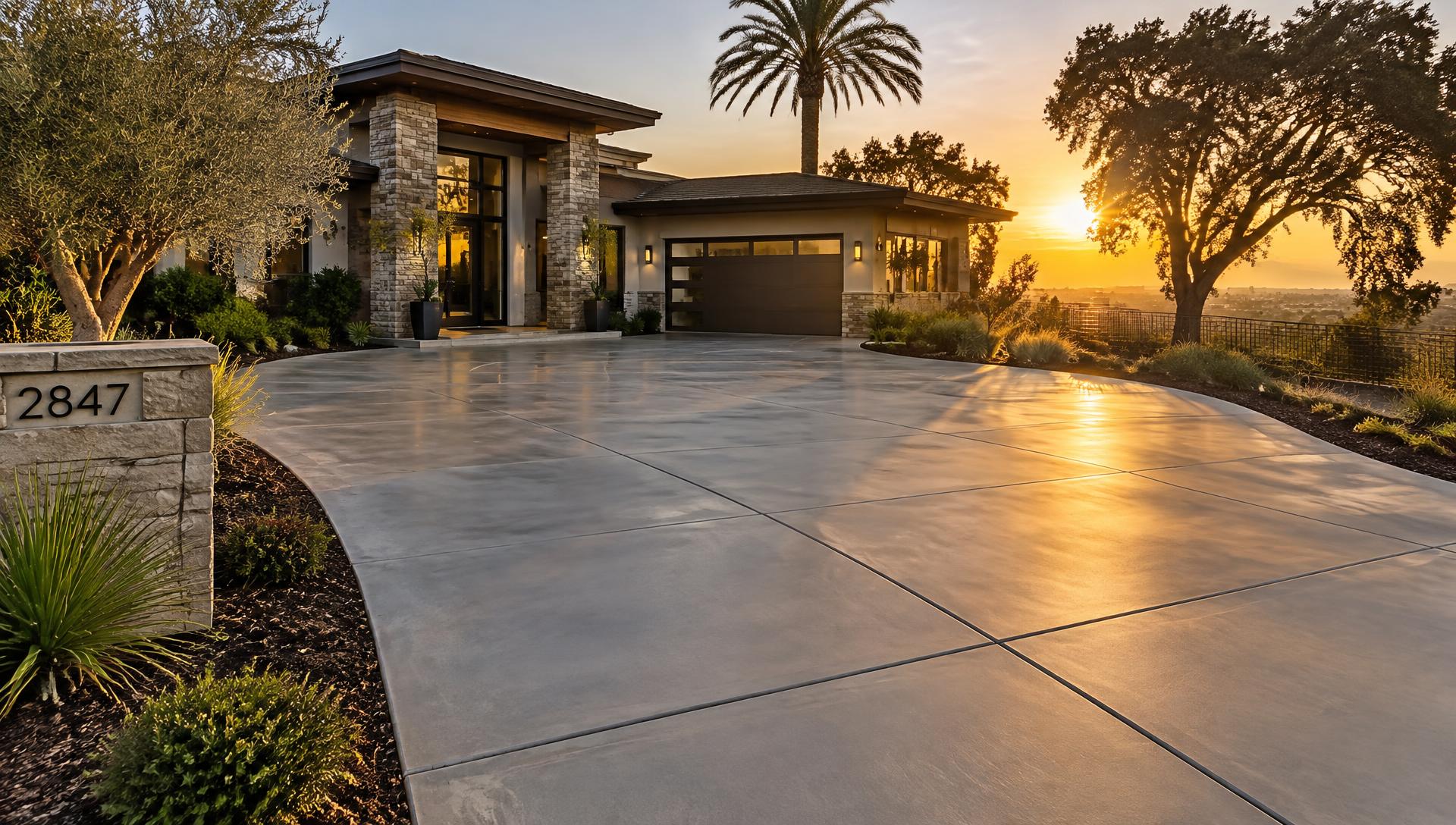
New concrete driveway poured in front of a Sacramento home at sunset
Typical thickness
4" residential, 5-6" for RV and truck parking
Mix design
3,500-4,000 PSI, 4-6% entrained air where specified
Reinforcement
#3/#4 rebar mat on chairs, 18" O.C. or engineered
Jointing
Early-entry saw cut, depth ≥ 1/4 slab, panels kept near square

Subgrade is the driveway

Before a single yard of concrete is ordered, we strip organics, cut to grade and compact in lifts to a uniform, non-yielding base. Where clay dominates, we moisture-condition rather than simply dry-roll it, because clay compacted dry rebounds the first time it rains.

  • Organic and root material removed, not buried under the slab
  • Class 2 aggregate base placed and compacted in controlled lifts
  • Proof-rolled to find soft spots before they become cracks
  • Positive fall away from the garage slab and house foundation

Reinforcement that actually stays in the middle

Rebar dragged up by hand after the pour does nothing. We tie mats and set them on chairs so steel sits where the engineer intended - in the lower-middle third - and stays there when the truck chutes hit the forms.

  • Tied mats on chairs, not mesh thrown on grade
  • Dowels into existing slabs and garage aprons where continuity matters
  • Thickened edges at driveway aprons and vehicle turning points

Jointing and finishing for Sacramento heat

Summer pours here can flash-set. We schedule early starts, use evaporation retarders when the wind picks up, and cut joints on an early-entry saw the same day so shrinkage relieves where we planned it instead of wandering diagonally across the panel.

  • Joint layout drawn before the pour, panels kept close to square
  • Broom, salt, exposed aggregate or smooth-trowel finishes
  • Curing compound or wet cure to slow surface moisture loss

Drainage, aprons and the street connection

Most driveway complaints in Sacramento are really drainage complaints. We plan slope, valley gutters, trench drains and apron transitions so stormwater leaves the slab instead of sitting against the garage threshold or pooling at the sidewalk.

  • Minimum practical cross-fall without creating a tipping edge
  • Trench drains at garage thresholds on flat or reverse-slope lots
  • City-standard drive approach work where the work touches public right-of-way

In depth

Concrete Driveways in Sacramento, explained properly

How Sacramento weather changes a driveway pour

Between June and September the valley regularly runs above 95 degrees with single digit humidity and a hard afternoon delta breeze. That combination pulls water out of the surface faster than bleed water can rise, and the result is plastic shrinkage cracking that appears before the slab is even walkable. We answer that with early morning placement, cool batch water, evaporation retarder on the surface and a finishing crew sized for the pour instead of a crew that finishes one panel while the next one flash sets. In winter the problem inverts: saturated clay subgrade holds water, so we check subgrade moisture before the truck is released and delay rather than pour a slab over a pumping base.

Panel layout, not just joint spacing

A rule of thumb says cut joints at two and a half times the slab thickness in feet, so about ten feet for a four inch slab. The rule is a floor, not a plan. Real driveways have re entrant corners at the garage return, a narrowing at the street approach, a side path tie in and often a curved edge. Every one of those geometry changes concentrates stress. We draw the joint grid around them first, keep panels close to square with a length to width ratio under one and a half to one, and isolate the slab from the garage stem wall and any column or post so the driveway can move without dragging on something rigid.

What replacement actually involves on an occupied property

On most Sacramento lots the driveway is the only way in and out, so the sequence matters as much as the concrete. We saw cut the removal line full depth so the break does not propagate into the neighbor slab or public sidewalk, stage removal so a walking path stays open, protect gas and irrigation lines that older properties often run shallow under the drive, and plan truck access ahead of time because many Midtown and East Sacramento streets cannot take a full boom or a ten yard truck parked across two lanes. Cure and traffic timing is set on day one so nobody has to guess when the car can come back.

What we build to

Standards and specifications on every concrete driveways project

  • ACI 302 guidance on slab tolerance and finishing sequence
  • Class 2 aggregate base to Caltrans specification under residential slabs
  • Rebar tied and chaired, not pulled up through wet concrete
  • Control joints cut same day with an early entry saw

What goes wrong elsewhere

The failures we are called in to replace

  • Wire mesh laid flat on grade and never lifted into the slab
  • Joints sawn a day late, after shrinkage cracks have already chosen their own path
  • Driveway poured hard against the garage slab with no isolation joint
  • Base compacted bone dry on expansive clay so it rebounds in the first storm
  • No fall away from the house, so stormwater ponds at the threshold

Local conditions

How Sacramento ground changes this work

Driveways near the American and Sacramento river corridors sit on sandy alluvium that drains well and compacts predictably. Move east toward Rancho Cordova, south to Elk Grove or north to Antelope and expansive clay takes over. The same slab detail is not appropriate in both places, which is why we look at the ground before quoting a section rather than after.

Before you call, it helps to have

  • Measure the existing drive and note where water currently goes
  • Photograph cracks, settlement and any garage threshold ponding
  • Confirm whether the work touches the sidewalk or drive approach
  • Decide finish and joint pattern before scheduling the pour
877-889-1187

Questions

Concrete Driveways - frequently asked

Still unsure? Call 877-889-1187 and describe the site. We would rather talk you out of unnecessary work than sell it to you.

Four inches is standard for passenger vehicles. We move to five or six inches with heavier reinforcement where RVs, work trucks, boats or dumpster deliveries are part of the picture, or where the subgrade is soft expansive clay.

Talk to a concrete contractor who works in Sacramento every day

Describe the slab, the site and what is going wrong. You will get a straight answer about what the work involves - including when we think you do not need us.

Mon-Sat 7:00 AM - 6:00 PM · Sacramento, Elk Grove, Roseville, Folsom & surrounding valley

Call 877-889-1187